 Ernie.SG

Build in Public: I Paid €40 for Passport Photos. They Got Rejected. So I Built My Own.

I recently became a Singapore citizen! 🇸🇬
Ironically, getting my citizenship approved wasn’t the hardest part. Getting my passport photo accepted by ICA was.
I spent €40 and half a day getting my photo taken twice in Barcelona. Even the professionally edited photos got rejected.
So I did what any frustrated software engineer would do: I wrote code.
I experimented with image generation first, but it subtly changed my facial features. Not exactly ideal for an identity document. 😂
Code-based image processing worked better. I could remove the background, crop, resize, and even fix the temporary cut I got from hiking on my face.
And it got accepted!
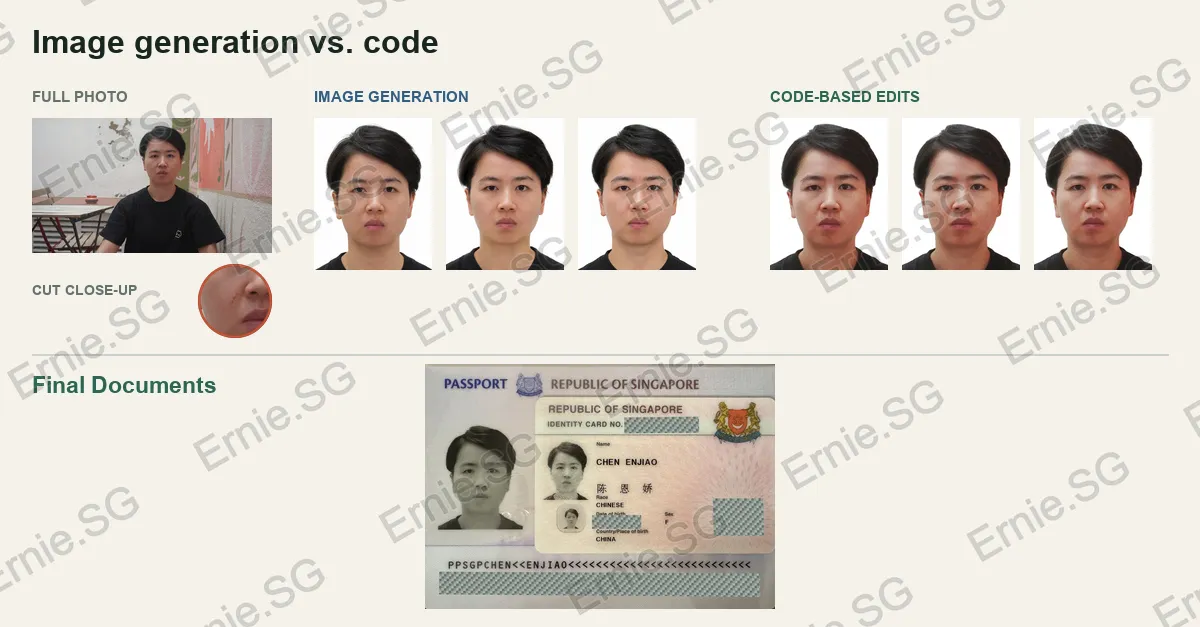
Image generation vs. code-based edits, with the final Singapore passport and IC below.
Everything Is Code
The worst part wasn’t the money or the time. It was that, after all that effort, the photos were still rejected. The photographer couldn’t meet the exact specifications, down to the pixel, and every additional touch-up would cost another €20.
Then it occurred to me: who better than AI to measure whether my face occupies exactly the right proportion of a photograph?
And all those manual edits in Photoshop - cropping, background removal, clone stamping - are ultimately software operations. Operations that AI can now write and execute as code.
So I’m building Spindle Photos.
Take a selfie. Choose your country and document. Get photos formatted and checked against the relevant requirements, with unlimited exports for supported documents.
No studio visits. No Photoshop. No €40 surprises.
Here’s a demo:
From Software as a Service to Outcome as a Service
That experience made me wonder: What products and services do we use every day that no longer make sense in a world of abundant intelligence?
A lot of the software we use today is inherited from an earlier era of deterministic computing. We built interfaces, forms, menus, and workflows around what computers could do, rather than what humans actually wanted.
But now we get to throw model intelligence into the mix!
At the end of the day, nobody uses software because they love clicking buttons or filling out forms. We use it to achieve outcomes we care about. Software was always just a means to an end.
I didn’t want photo-editing software. I didn’t even want a photographer. I just wanted a passport photo that would get accepted.
And why stop at photos?
Schools, hospitals, banks, and government agencies still make us fill out the same information over and over again. Why can’t I just point my AI at a form and have it figure things out?
And it’s not enough for AI to simply search through my files and produce an answer. I want to know exactly where it got each piece of information, verify that it’s correct, and have it ask me only for what’s missing.
I don’t want AI to write like the median of the internet, either. I want it to sound like me, only better at expressing what I’m actually trying to say.
The point isn’t to preserve existing workflows as relics. It’s to redesign them around the outcome.
If the previous era of the internet gave us Software as a Service, perhaps the next will give us Outcome as a Service.
And that’s where I’d love to see the productivity gains from AI accrue: in essential services like education, healthcare, housing, and even the mundane business of interacting with government.
Not just cheaper software or bigger corporate margins, but less administrative work for teachers and healthcare workers, fewer hoops to jump through for citizens, and more time for everyone to spend on things that actually matter.
We spent decades learning how to use computers. Now we have an opportunity to make computers work around us instead.
That’s the bigger idea behind Spindle: take all the things I hate doing - things I might never have gotten around to without AI - and make that capability accessible to everyone.
So… launch in 30 days? 🚀